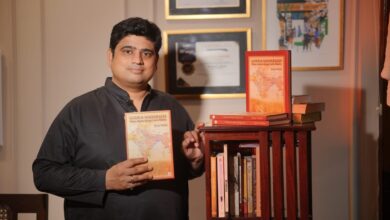
The House I Built in My Mind by Author Saiyu: A Poetic Journey Through Girlhood, Grief, Healing and Becoming

What if healing isn’t about moving on, but about walking through every room you tried to lock?
Betty builds a house out of everything she cannot say out loud.

Each room holds a different part of her—a memory, a fear, a longing, a loss, a version of herself she has not yet learned to let go of.
Through poetry and prose, The House I Built in My Mind moves through the intimate landscape of girlhood, grief, growing up and becoming.
There is the porch where hope arrived too early, the kitchen where hunger meant more than food, the bathroom where breaking was disguised, and the bedroom where love continued to echo long after it had left.
Room by room, Betty confronts the things she has carried silently: loving too deeply, losing too suddenly, performing strength, breaking quietly and trying to understand the person she is becoming.
Written from a deeply personal emotional landscape, The House I Built in My Mind explores what it means to grow up before you fully understand who you are.
Tender, introspective and vulnerable, the book is an invitation to sit with difficult feelings rather than immediately trying to explain, fix or escape them.
Because sometimes healing does not mean leaving the house behind.
Sometimes, it means finally opening the doors.
What if your mind were a house—and every room held a version of you that you hadn’t learned to let go of?
In The House I Built in My Mind, young writer and musician Author Saiyu transforms memories, grief, girlhood and the uncertainty of growing up into a house made of poetry and prose.
The book follows Betty, a character shaped by both personal experience and the experiences of many young women navigating the complicated space between childhood and adulthood.
Written from the perspective of someone still close to the experience of growing up, the collection asks a simple but powerful question:
1. What inspired you to write this particular book, and how did the idea for the story come to you?
I think this book began with me realising that I needed somewhere to put everything I was feeling. I did not always understand my emotions while I was going through them, but I knew I wanted to give them some shape, so I started writing them down.
I started writing when I was thirteen, but the writing that eventually became The House I Built in My Mind began around the age of eighteen or nineteen. There was no plan to write a book at first. I was simply writing whenever something stayed with me long enough that I felt I had to put it somewhere.
Some poems came from grief, some from girlhood, some from the fear of growing up, some from wanting to become something, and some came from feelings I could not properly name at the time.
Eventually, I had all these pieces sitting together and started wondering what they were becoming. I thought about dividing them into chapters, but that did not feel right. They felt more like different spaces inside the same person.
That is when I thought of a house.
I imagined a quiet house near a lake, with wooden doors and glass frames, filled with memories, emotions and scars. A house that belongs to Betty and, in a way, is Betty.
2. Can you share some insights into your writing process? Do you follow a specific routine or have any unique rituals that help you get into the creative flow?
I don’t think what I do can even be called a routine. I don’t sit down at a particular time and decide that I am going to write a certain number of lines, sentences or poems.
Mostly, a feeling comes first and writing follows.
Sometimes I will be in my room; sometimes I will be doing something completely unrelated, like studying for my exams; sometimes I will be in the middle of a party or lying awake at midnight trying to sleep. Suddenly, I will have a line or a feeling that I need to write down. If I don’t, I feel very unsettled.
So I write it in my diary, a notebook, on a page, or in my notes app.
Sometimes one feeling or emotion gives me one poem. Sometimes everything seems to arrive together and I end up writing three or four.
Music is also a very big part of how I write. I am a singer and musician, so sometimes a poem starts as something I hum. I will sit at the piano, find a melody, and start putting words to it. Sometimes it becomes a song, and sometimes it becomes a poem.
So I don’t really have a method or routine.
I believe that if I force it, it can’t be honest. I think I just pay attention when something inside me wants to be written.
3. The characters in your book are quite distinct and memorable. Are they based on real people, or did they evolve purely from your imagination?
Betty is the heart of the book, and she is probably the character closest to my heart.
I actually wrote her when I was seventeen for a completely different concept. That idea never became something, but Betty stayed with me. When I started working on The House I Built in My Mind, I realised she belonged here.
She has a lot of similarities to me, but she is not exactly me.
I also think she comes from many girls rather than one particular person: girls who were quiet, girls who were called “too much,” girls who were still trying to become someone, girls who were dealing with so many emotions without really knowing what to do with them, and the girl I have been.
That is where a lot of Betty came from.
This is my first book with a character in it, and I was honestly confused about whether I should even keep her until quite late in the process. But eventually, it felt strange to imagine the book without her.
The other people are mostly shown through Betty’s point of view. There is also a narrator in the prose sections who allows the reader to see Betty from slightly outside herself.
4. Your book delves into girlhood, grief, teenage years and becoming. What motivated you to explore these themes, and what messages or discussions do you hope readers will take away from your work?
These are things I was already thinking about and feeling, so I didn’t really have to search for the themes.
I think growing up can be quite confusing because everyone keeps asking what you are going to become while you are still trying to understand who you are.
Betty is close to twenty, and she feels like she should have everything figured out before she gets there. There is this pressure within her to become a certain version of herself, and I think that feeling is very familiar to a lot of young people.
I also wanted to write about grief in a way that felt closer to real life. Sometimes grief is not one huge moment. Sometimes you wake up, make breakfast, go through your day, and it is still sitting somewhere inside you.
I want readers to feel that they are allowed to feel things without having to immediately understand them, explain them or fix them.
If someone reads this book and finds a feeling they once thought belonged only to them, I think that is enough.
5. The world-building in your novel is incredibly rich and immersive. How did you go about creating the setting, and did you draw inspiration from any real-world locations or historical events?
The setting came almost entirely from emotion—from the idea of the mind becoming a house.
I imagined Betty’s house as a quiet house near a lake. It is a lone house with wooden doors, glass frames and rooms filled with memories. From the outside, it might seem peaceful, but inside, it holds everything Betty has carried with her.
The house is really her mind made physical.
I kept thinking about what it would look like if different emotions had their own rooms. Where would a memory stay? Where would grief sit? What would a room look like if it belonged to a version of yourself that you had not completely let go of?
Those questions shaped the setting more than any real location did.
So, it is not based on one particular place or historical event. It came from the emotional world of the book.
The house became the way I could show what was happening inside Betty without having to explain everything directly.
6. As a writer, how do you balance the need for originality with the expectations of the genre? Were there any challenges in putting your unique spin on familiar elements?
Originality was something I was very conscious of while writing this book.
I have influences. Of course I do. There are songs I love, writers I admire, lines that have stayed with me, and pieces of art that have made me feel something. I don’t think any writer exists completely untouched by what they have consumed.
But I cared a lot about making sure the book still sounded like me.
There were moments when I would stop and ask myself, “Does this actually belong to my voice, or am I unconsciously writing towards something I have already seen somewhere else?”
I wanted someone to read the book and recognise my writing.
Not because I think everything I have written is completely new or that nobody has ever written about these emotions before. They have. But these are my experiences, my way of looking at them, and my way of putting them into words.
I also did not want to force depth into the writing.
I think when you are writing about emotional things, there can be a temptation to make everything sound heavier or more poetic than it really is. I wanted to avoid that. If something was simple, I wanted it to stay simple.
I think honesty makes writing feel more personal than trying too hard to sound profound.
The House I Built in My Mind
What if healing isn’t about moving on, but about walking through every room you tried to lock?
Betty builds a house out of everything she cannot say out loud.
Room by room, she traces the shape of growing up—loving too deeply, losing too suddenly, performing strength, breaking quietly, and learning how to rebuild anyway.
Built from memory, grief, girlhood and resilience, The House I Built in My Mind is a collection of poetry and prose exploring the tender, often painful space between who we are and who we are becoming.
It is a book about the feelings we struggle to name, the memories we carry, and the parts of ourselves we are still learning to understand.
You don’t need to bring much.
Just yourself.
“I may not know everything about growing up yet, but I know what it feels like to be in the middle of it.” — Author Saiyu
What if the things you have tried to forget are actually the rooms you need to enter?
Discover The House I Built in My Mind by Author Saiyu a tender collection of poetry and prose about girlhood, grief, love, growing up and finding your way back to yourself.
Order your copy on Amazon today.Read the poems. Open the doors. Meet the parts of yourself you thought you had left behind.