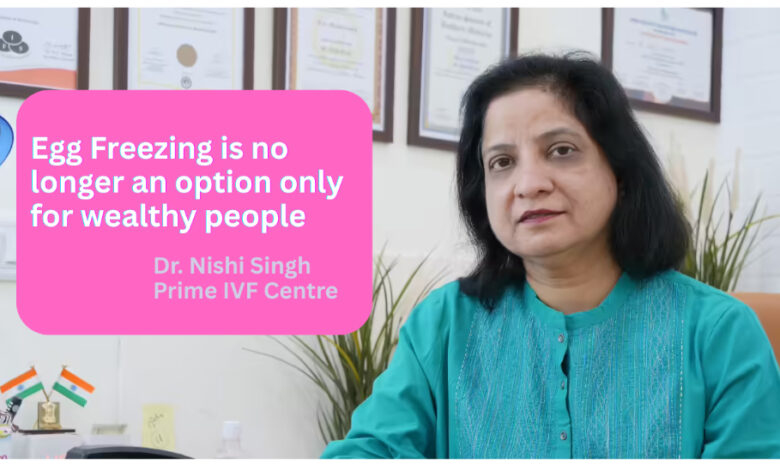
Egg Freezing is no longer an option only for wealthy people – Says Dr. Nishi from Prime IVF
The average age at which Indian urban women are having their first child is rising steadily. Education, professional ambition, financial independence and the search for the right partner are all legitimate reasons why women are deferring motherhood. But many are unaware of a medical option that could preserve their future fertility choices: egg freezing. Fertility preservation through oocyte cryopreservation, commonly known as egg freezing, has been available for over two decades, but it was historically associated with cancer patients undergoing treatments that threatened ovarian function. Today, elective fertility preservation for social or medical reasons is one of the fastest-growing segments of reproductive medicine globally. The technology has advanced significantly. Vitrification, a flash-freezing technique that prevents the formation of ice crystals that can damage egg cells, has dramatically improved the survival rate of frozen eggs. Survival rates above 80 percent and fertilisation rates comparable to fresh eggs are now routinely achieved at well-equipped centres.
“Biology is straightforward. A woman’s egg quality and quantity both decline with age, and the decline accelerates after 35. If a woman in her late twenties or early thirties freezes her eggs, she is essentially preserving her fertility at that age for future use. If she comes back at 39 or 40 and wants to start a family, her chances of success using those frozen eggs will be significantly better than using eggs retrieved at that later age. Egg freezing does not guarantee a baby — but it meaningfully extends the window of possibility.”


— Dr Nishi Singh, Head of Fertility at Prime IVF Centre
The process involves a short course of hormonal stimulation, typically 10 to 12 days, to encourage the ovaries to produce multiple mature eggs in a single cycle. These eggs are then retrieved under sedation in a minor procedure and immediately vitrified and stored. Most women return to normal activities within a day or two. The number of eggs required to give a reasonable statistical chance of one live birth varies with age. At 30, retrieving 8 to 10 mature eggs may be sufficient. At 35, 15 to 20 eggs may be advised to account for the higher rate of chromosomal abnormality in older eggs. At 38 or beyond, multiple cycles may be needed. This is why timing matters, the earlier a woman considers preservation, the better the efficiency of the process.
Ovarian reserve, the quantity of eggs remaining in the ovaries, varies significantly between individuals of the same age. Anti-Mullerian hormone, or AMH, measured through a simple blood test, and antral follicle count, assessed by ultrasound, provide an accurate picture of a woman’s current ovarian reserve. These tests are the starting point for any fertility preservation consultation. Fertility preservation is also increasingly relevant for women with medical conditions that may affect fertility prematurely. Endometriosis, autoimmune disorders, a family history of early menopause and certain genetic conditions such as Turner syndrome or BRCA mutations are all clinical indications for fertility preservation consideration before natural fertility is significantly compromised. The cost of egg freezing in India has declined with wider availability, though it remains a significant expense. Clinics in metropolitan India typically charge between 80,000 and 1,50,000 rupees per cycle, exclusive of medications. Annual storage fees add to the long-term cost. Specialists argue that the investment needs to be framed in context, the alternative, for a woman who delays and finds her fertility severely reduced, may be much more expensive interventions with lower success rates.
Awareness remains the largest barrier. In India, conversations about fertility preservation are only beginning to enter public discourse. Corporate wellness programmes, women’s health initiatives and social media education campaigns are slowly changing this. But the most important conversation remains the one between a woman, her doctor and the facts about her own reproductive health.